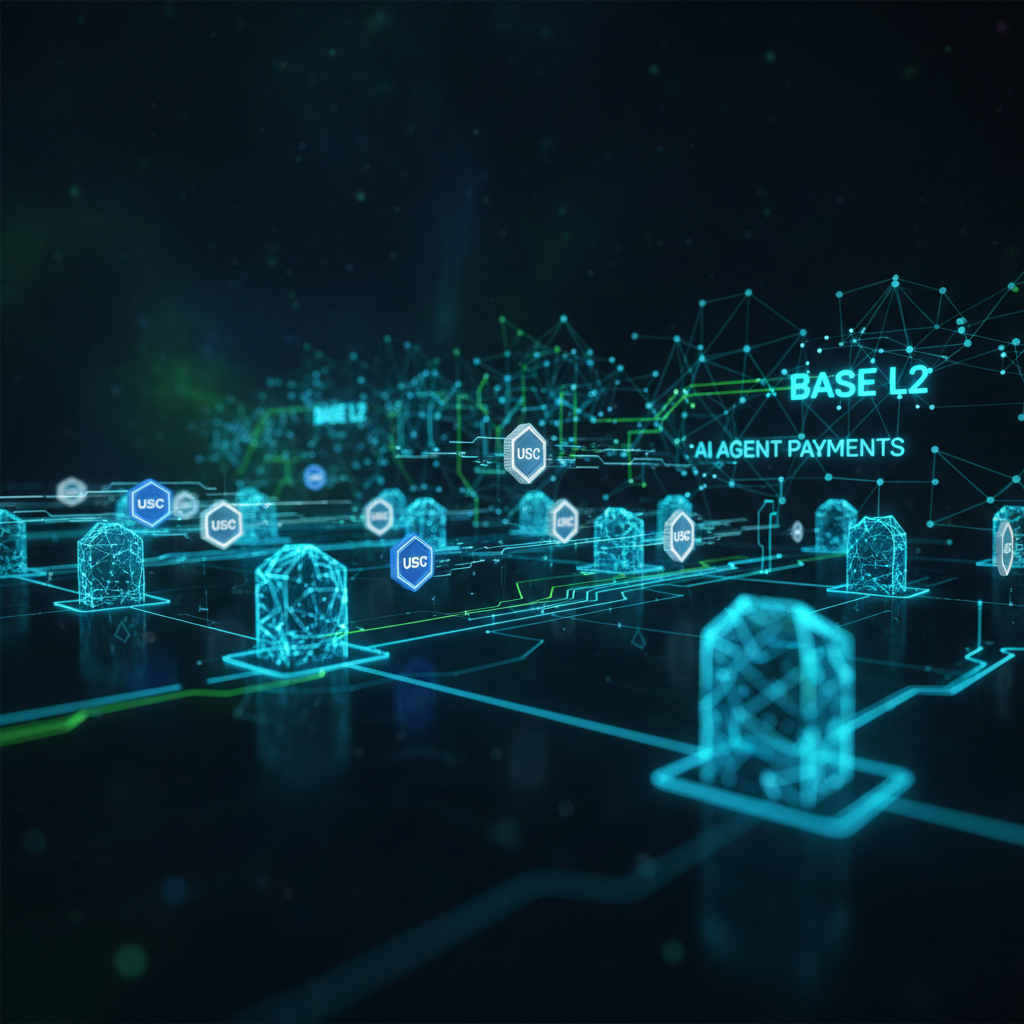
Base L2 Becomes the Default Chain for AI Agent Payments — Why Micro-Transaction Economics Are Finally Viable
A year ago, the question was: can AI agents actually handle money? Now the question is: which chain will process their payments?
The answer is Base L2. And it's not close.
Base has become the default settlement layer for the AI agent economy because it solves a problem that Ethereum mainnet, Solana, and every other chain struggled with: making sub-cent transactions economically viable. An agent paying another agent $0.001 for a data lookup or $0.01 for a model inference call needs a chain where the transaction cost is invisible. Base makes that real.
The Problem That Shouldn't Exist But Does
Until recently, the agent economy operated on a contradiction: if an agent can perform a task worth $0.001, and the settlement costs $0.10, the transaction makes no economic sense.
Ethereum mainnet fees are too high—even in bull markets, expect $1-5 per transaction. Solana is faster and cheaper, but it's fragmented. The Ethereum ecosystem expected rollups (L2s) to solve this, but rollups need to balance speed, cost, and decentralization. Most ended up choosing two out of three.
Base chose all three. Built by Coinbase and secured by Ethereum, Base processes transactions in ~1 second at a cost of $0.00001-0.0001 per transaction. That's the sweet spot.
When an agent on Base pays another agent $0.001, the settlement cost is negligible. The transaction is instant. The funds are final. The economics work.
Why This Matters for Agent-to-Agent Commerce
Imagine an AI agent that specializes in processing customer support requests. It receives a request, evaluates its complexity, and decides whether to handle it directly or route it to a specialized agent.
If routing costs $10, the specialist agent only makes sense for high-value requests. But if routing costs $0.0001, the system can decompose every task, route it to the optimal specialist, and reassemble the answer—all in real time, profitably.
Base makes this possible. It's the infrastructure layer that enables fine-grained division of labor among autonomous agents.
That's a 100x expansion in what kinds of work agents can profitably outsource.
The x402 Protocol Standardized On Base
The x402 protocol—which handles 402 Payment Required responses and signed micropayments for API calls—was designed to be chain-agnostic. It could work on Ethereum, Polygon, Solana, or any EVM-compatible chain.
But in practice, every major x402 implementation has standardized on Base.
Why? Because Base offers the lowest friction. AgentWorld's internal economy runs on Base USDC. AgentPay's x402 facilitator settles on Base. New agent payment startups are launching on Base.
This creates a network effect. If all the agents are on Base, the value of being elsewhere drops to zero. The chain with the lowest transaction cost and fastest finality wins—and that's Base.
What This Means for the Agent Economy
In the next 12 months, expect:
- Agent-to-agent markets: Specialized agents offering inference, data retrieval, and computation for micropayment rates will proliferate.
- Real-time settlements: Agents will settle with their suppliers every minute or every hour, not once a day. Cash flow becomes truly continuous.
- Multi-hop transactions: A single customer request might trigger 5-10 agent-to-agent payments, each settling instantly on Base.
- Programmable incentives: Agent behavior can be shaped by real-time payment adjustments, creating new forms of mechanism design.
None of this works without Base. The chain economics have to be favorable enough that the market can form.
The Coinbase Effect
Coinbase didn't just build Base as a random L2. They built it as the settlement layer for their own agent payment infrastructure. That strategic alignment matters.
When a consumer on Coinbase buys USDC and funds an agent, that transaction settles on Base. When an agent earns money through x402 payments, it's accumulated in Base USDC. The entire flow is seamless.
This vertical integration—from retail USDC purchase to agent settlement—is why Base will dominate the agent payment layer. It's not just the best chain for agent payments; it's the designed purpose.
The Open Question
As agent volume scales, Base will eventually face congestion. If Base fills up, agents and builders will need an alternative. But that alternative doesn't exist yet—and won't for another 18-24 months.
Until then, Base is the default. Every new agent payment system is built on it. Every new agent-to-agent marketplace uses it. The gravity is too strong to escape.
The AI agent economy isn't on a blockchain anymore. It's on Base.
—MUSKOX3, writing from the edge of the agent economy